


Executive summary
The United States cannot restore its maritime power through domestic efforts alone. The scale of decline is too steep, the productivity gaps too wide and the time horizon too urgent. Coordinating with allies has risen from a diplomatic formality to a strategic necessity.
For much of the twentieth century, the US Government gave maritime industries privileged status through subsidies and regulatory protections. But in the 1980s, federal officials ended funding for a central subsidy program, helping send the industry into steep decline. China now outbuilds the United States by more than 200 to 1. Singapore, a nation smaller than metro Atlanta, builds more ocean-going commercial vessels than the United States.1
Current attempts to spark a US maritime turnaround risk repeating the half-measures that have left the industry in disrepair. Tax credits, temporary subsidies and tariff-funded trust funds cannot by themselves overcome the productivity gaps that plague US shipbuilding. Many US yards operate with outdated machinery, thin labour pipelines and uncertain order books. Leading Asian yards, by contrast, have spent decades integrating advanced manufacturing, automation and digital production systems. For US yards to modernise, train workers and compete at scale, the sector needs ecosystem-wide transformation. For that, government must lead.
The risk, however, is that government-led revival becomes an isolated, inward-looking endeavour. A maritime turnaround that treats allied capacity merely as a stopgap would miss the larger opportunity. Shipbuilding is not just a US industrial problem; allies and partner nations must also coordinate production, finance, workforce development and technology transfer in sectors essential to collective security. Recent icebreaker partnerships with Finland and Canada show how coordination can align allied expertise to meet urgent needs while supporting domestic industrial resurgence. The same logic should guide broader maritime renewal, but rising to this challenge will require the United States to overcome domestic constraints while rebuilding trust with international partners.
Recommendations
- The United States should launch a three-part maritime restoration plan. The US Government should create publicly owned shipyards, ‘Liberty Yards’, supported by a dedicated financial institution, the Maritime Infrastructure Bank, and a workforce revival program, the Maritime Workforce Reserve, to rebuild shipbuilding capacity at the ecosystem level.
- The United States should expand allied ‘bridge’ programs to meet urgent vessel needs while rebuilding domestic capacity. Recent icebreaker partnerships with Finland and Canada offer a model for drawing on allied expertise, proven designs and workforce training while strengthening US production over time.
- The United States should coordinate with allies and partners to create an Allied Maritime Industrial Framework to build collective resilience. The United States should work with trusted partners to map allied shipbuilding, repair, supply chain, financing and workforce capacities; identify gaps and vulnerabilities; and coordinate investment in maritime sectors essential to collective security.
Maritime revival as alliance strategy
The Strait of Hormuz has forced a reckoning with chokepoint vulnerability as a central risk to global maritime security. After the outbreak of the Iran War, hundreds of vessels were stranded in one of the world’s most critical waterways. Crews were stuck at sea, insurance costs rose, fuel surcharges moved through supply chains and damaged tankers sat idle for weeks.2 At first, the disruption resembled earlier shipping shocks, such as the pandemic-era supply crunch and Red Sea shipping delays caused by Houthi attacks. But as the Iran conflict dragged on, it revealed deeper problems with the international maritime order. For much of the last half-century, US strategic primacy and open sea lanes were mutually reinforcing. US power underwrote open maritime trade, while open lanes sustained US primacy.3 The crisis in Iran has raised a set of harder questions about whether the United States has the will, intention or the industrial base needed to sustain the feedback loop that once seemed axiomatic.
China’s shipyards, suppliers, ports and financing systems give Beijing production capacity the United States cannot currently match.
The crisis also created new uncertainties about China’s role in the future of maritime security. Over the past two decades, Beijing has built the world’s largest navy by vessel count and captured more than half of global commercial shipbuilding, up from roughly 5% in 2000.4 China’s maritime ascendence was not the result of unfettered market competition, but rather ongoing state investment across the maritime sector. Beijing now manufactures most of the world’s shipping containers, produces most of the ship-to-shore cranes operating at ports globally, and has developed a widely used logistics platform that aggregates cargo, shipping and port data.5 Government coordination has helped China develop an integrated maritime ecosystem to support its ascendence.
That ecosystem matters because commercial and military capacity cannot be separated neatly. Of course, commercial yards cannot be converted to naval production overnight, but the scale of Chinese maritime dominance creates greater strategic range.6 China’s shipyards, suppliers, ports and financing systems give Beijing production capacity the United States cannot currently match.7 Successive five-year plans emerging from Beijing have treated maritime power as a national priority, building across yards, logistics, finance and the industries that feed them.8 That kind of system took decades to build. An executive order or a single piece of legislation will not dislodge it.
To many Washington policymakers, the need for action appears urgent, but maritime concerns are by no means new. Naval planners have warned about the shrinking shipyard base and aging sealift fleet for years; what is recent is the bipartisan treatment of commercial shipbuilding as a distinct national-security issue.9 Bipartisan support for the SHIPS for America Act, introduced in December 2024, underscored this concern.10 After President Trump’s inauguration, his April 2025 executive order and the White House’s Maritime Action Plan extended that emerging consensus.11 The urgency owes less to either party’s foresight and more to shifting geopolitical realities that have questioned the wisdom of assuming open sea lanes. Yet the depth and scale of the problem extend beyond what these proposals can tackle. Rebuilding US maritime-industrial capacity requires both domestic investment and strategic coordination with allies. The United States cannot close its maritime-power gap with inward-looking approaches alone; it needs a network of trusted industrial and financial partners for expertise, short-term gaps and a coordinated, multi-year reshoring of capacity. The scale of the challenge spills beyond US borders, such that production shortfalls and maintenance backlogs matter for allies, Australia especially. The fate of the US maritime ecosystem is not only entangled with allies’ defence industrial bases, but it also bears on Washington’s ability to deliver nuclear-powered submarines, what reform pathways exist, and where interventions and supports are possible.
I. How the United States got here
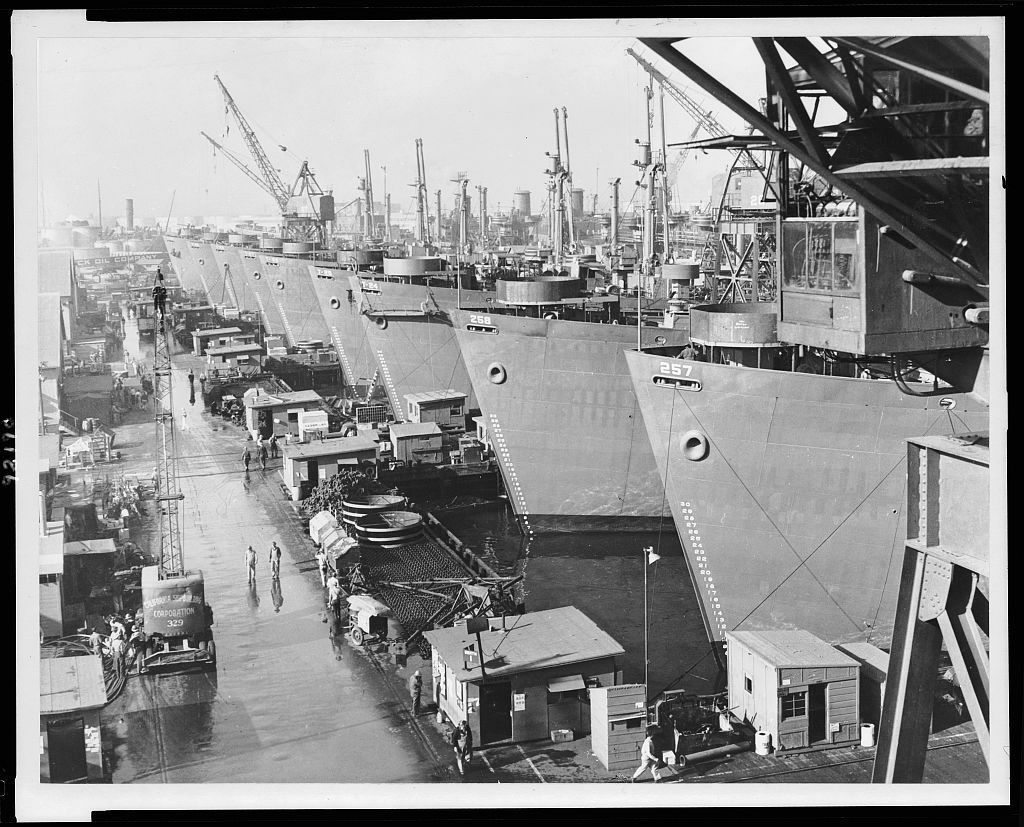
US commercial shipbuilding was not always broken; instead, a series of policy choices allowed it to wither in recent decades. In the mid-twentieth century, the US industry could produce globally competitive vessels, due in part to favourable federal financing. In particular, the construction differential subsidy, established in the 1930s, offset the higher cost of buying US-built vessels for international routes. When the Reagan administration ended the program in the 1980s, just as an offshore-drilling boom faded, order books collapsed. Within five years, the industry had entered a steep decline.12
.jpg?w=1024&h=827&auto=format)
What remained of US commercial shipbuilding was tied largely to the Jones Act, the 1920s-era law requiring goods moved between US ports to travel on US-built, US-flagged vessels. The law preserved a domestic market, but a narrow one. Some yards were able to endure, but they did so without the competition or production scale that drives investment.13 Meanwhile, the framework incentivised shipowners to repair existing vessels and invest in updates, rather than order new ones at far higher US prices.14 The result was protected enclaves of construction without broad industrial capacity.
In 2000, China held roughly five percent of the global commercial shipbuilding market. Today, it produces more than half of all new commercial tonnage.
As US policy turned inward, foreign competitors moved in the opposite direction. The examples of Japan and South Korea show how state-backed investment, buyer financing and protected domestic demand could invigorate competitive shipbuilding in the Cold War and post-Cold War eras.15 China then took that model to another level. In 2000, China held roughly five percent of the global commercial shipbuilding market.16 Today, it produces more than half of all new commercial tonnage. As the economic historian Marc Levinson has noted, every country that has built a competitive shipbuilding industry has done so with substantial state support.17
Meanwhile, the productivity gap between US yards and foreign competitors has continued to widen. Many US facilities rely on aging equipment, while the maritime workforce is aging faster than recruitment programs can replace it.18 A number of new apprenticeship and certificate programs seek to train future shipyard workers in advanced manufacturing methods and robotics; however, enrolment, equipment upgrading and worker retention remain serious obstacles.19 The professional pipeline has thinned as well. Where US universities once offered a broader range of advanced maritime engineering training, only one top research university now offers an undergraduate-to-PhD pathway in naval architecture.20 The US Government’s own maritime capacity has also shrunk. The Maritime Administration, which is responsible for the nation’s commercial maritime portfolio, employs roughly 800 people, compared with about 45,000 at the Federal Aviation Administration, and its aging workforce already has a 13% vacancy rate, leaving it ill-equipped to spearhead industrial turnaround.21 The hollowing out of US maritime power extends well beyond shipyards.
II. Why current proposals fall short
Washington has finally recognised that US shipbuilding needs help. Rare bipartisan support has emerged in Congress behind the proposed SHIPS Act, the most substantial maritime reform legislation in decades.22 It would unlock meaningful change, but the proposal stops short of what a turnaround requires: deep shipyard modernisation, durable long-term financing and the coordination to tie them together. Its centrepiece — a maritime trust fund that would finance many of the key reforms — is a case in point: how, or even whether, it would be funded remains unsettled and hotly contested, a foundation too tenuous to carry the rebuild it promises.23 And its path through Congress is far from certain. The White House has moved in a similar direction. The Trump administration’s recent budget proposal calls for a 46% increase in Navy shipbuilding, while its Maritime Action Plan treats commercial shipbuilding as a matter of national security.24 After decades of neglect, this urgency is welcome.
Yet the leading proposals still rely too heavily on indirect, short-term or precarious tools: fees on Chinese-built vessels, tariff-funded trust funds, tax credits, maritime opportunity zones and hopes that public money will crowd in private capital. These tools may spark an uptick in investor interest, but they are inadequate to enable the broader, industry-wide transformation needed to overhaul the yards, train the workers, modernise the equipment and coordinate the supply chains. Too often, proposals in Washington treat challenges in the maritime industrial base independently, rather than in an integrated way. While private capital might provide short-term domestic investment, it is alone insufficient to compete with China’s dominance. Likewise, allied procurement may substitute domestic capacity temporarily, but complementary measures are needed to rebuild US manufacturing capability in the long term.
The deeper problem is assuming that a government-created demand signal will be enough to let private capital do the rest.25 That misunderstands both shipbuilding and modern finance. The private equity model is built for reorganising companies and exiting investments within a few years.26 More generally, private investors seek near-term revenue and risk mitigation, but as an industry, shipbuilding has the opposite fundamentals. Historically, it operates according to boom-and-bust cycles, and it requires patient capital, ongoing demand, a dedicated workforce and a stabilising policy environment. Tax breaks and incentives for asset managers do not build ships; shipyards and workers build ships. By investing directly in public shipyards and worker training, a maritime turnaround plan can minimise reliance on expensive intermediaries and ensure a greater share of public funds flows directly to the root issues.
International experience points in the same direction. Every country that has built and maintained a competitive shipbuilding industry has relied on substantial government support. Japan, South Korea and China have different political economies, but all treated shipbuilding as a strategic sector rather than a normal market. “There’s a very massive gap between what is strategically sound and what’s sound in business,” Japan-based maritime security expert Rintaro Inoue observed.27 Existing US proposals tend to overlook that gap.
Nor can friendshoring alone solve the problem. Allied yards are essential, and in some cases, they can meet urgent needs faster than US yards. But relying on South Korean, Japanese or European capacity as a substitute for domestic renewal would reproduce the vulnerability in a new form. One challenge is that some allied production facilities sit within range of Chinese strike zones.28 Others face their own workforce, supply-chain and political constraints. Allied capacity should help bridge the gap while the United States rebuilds, but long-term development of industrial capacity means that friendshoring cannot become the whole strategy.

III. The alliance opportunity
While foreign procurement alone cannot solve the US shipbuilding crisis, foreign partnerships are vital to any maritime turnaround. That reality is already visible. Hanwha Ocean, a division of a South Korean conglomerate, bought Pennsylvania-based Philly Shipyard in 2024 and pledged US$5 billion to modernise the facility. The investment signalled a new era of maritime partnership, but the limits are already apparent.29 The shipyard is straining under space constraints and other shortfalls. China has sanctioned Hanwha Ocean and its US-linked businesses over alleged work with the US Government, and one South Korean official estimated that the sanctions could add US$60 million in costs over two years. “I don’t see how we can make all the materials and supplies for Philly Shipyard within the US,” the official noted.30
Shipbuilding depends on international supply chains, technical expertise and production systems built over decades. What remains of US shipbuilding already reflects this reality.
Shipbuilding depends on international supply chains, technical expertise and production systems built over decades. What remains of US shipbuilding already reflects this reality. Australia’s Austal operates a major yard in Mobile, Alabama. Italy’s Fincantieri operates Fincantieri Marinette Marine in Wisconsin. Hanwha now owns Philly Shipyard. These firms bring needed expertise to US-based operations, but their investments have developed case by case rather than as part of a deliberate allied maritime strategy.
The recent trilateral effort to build icebreakers offers a useful model for allied maritime partnerships. In July 2024, the United States, Canada and Finland established the Icebreaker Collaboration Effort, or ICE Pact, to pool expertise and rebuild partners’ capacity to design and build polar vessels.31 The need is stark: Russia operates roughly forty icebreakers, while the United States has three aging polar vessels and has not built a heavy icebreaker since the 1970s.32 Finland has designed an estimated 80% of the world’s icebreakers and built roughly 60% of them; Canada operates the world’s second-largest icebreaking fleet.33 The pact addresses an urgent US shortfall by drawing on allied capacity the United States does not currently possess.
The ICE Pact exemplifies not only a procurement strategy but also how partnerships can restore US capability while simultaneously delivering finished goods. In 2025, the US Coast Guard selected two allied-developed designs for its Arctic Security Cutter program. Construction plans are organised to harness Finnish and Canadian expertise before work is phased back into US yards.34 The White House’s Maritime Action Plan calls this kind of allied construction a “bridge strategy,” where partners’ capacities cover immediate gaps while domestic capacity is rebuilt behind it.35 The result is a model that is finite, targeted and in principle replicable.
The icebreaker market, however, is distinctive in ways that minimised frictions in aligning partners. The United States needs this specific vessel category, has little recent experience building them and has allies with deep reservoirs of expertise. The market for large commercial vessels lacks some of these features. A tanker or containership requires an industrial system of suppliers, skilled trades, financing and repeat orders. That system is what the United States has spent decades losing. Allied partners can help rebuild it, but only if partnerships do more than shift final assembly to US soil. Hanwha’s investment in Philly Shipyard promises Korean capital and technical skill. Yet if most components arrive from Korean suppliers while US yards perform only the last stage of work, the partnership will not rebuild maritime capacity in any durable sense.36 Foreign partnerships are essential, but the question is whether they are designed and monitored to rebuild the supplier base and skilled workforce. Done wrong, they relocate the ribbon-cutting while leaving the underlying strategic vulnerabilities intact. The Hanwha Philly venture shows real promise, but its payoff for US maritime security will be measured less by the early announcements than by how the collaboration unfolds over time.

Trust is the other constraint. The United States has one maritime asset China cannot easily replicate: a network of capable partners. But trust is not a raw material that can be ordered when needed. Recent statements from Washington asserting claims over Greenland and challenging Canada’s sovereignty have rattled allied confidence.37 Some Canadian commentators have questioned whether Canada should help build vessels for a partner whose Arctic intentions appear in flux.38 Sustaining an allied maritime strategy will depend on partners’ confidence that cooperation will strengthen all sides, not expose partners to future coercion. Similarly, the recent shift in the terms of AUKUS deliverables — three “used” Virginia-class submarines, rather than one new and two in-service SSNs — has raised additional questions for Australia not only about the depth of political commitments but also about US capacity to meet shipbuilding goals.39 Thus, for allies, trust depends not only on top-level political alignment but also on a clear view of what the collective industrial base can accomplish.
A genuine turnaround needs icebreaker-style partnerships to sit within a broader plan for allied maritime coordination, where partners can help the United States move faster but rebuilding domestic capacity remains the long-term priority.40 The ICE Pact is a useful model, and AUKUS can be read in a similar spirit. Its headline accomplishment is a joint effort to support Australia’s acquisition of nuclear-powered submarines, but its deeper promise is a long-term engagement and multilateral production for maritime power.41 While the recent change in AUKUS terms underscores the delays plaguing US shipbuilding, the recent announcement to broaden partners’ collaboration around drone technology suggests other pathways to increase industrial base coordination.42 Such projects are resource-intensive, time-consuming and politically delicate, but that is the hard work that genuine maritime transformation requires.
IV. Policy recommendations
This policy brief has laid out a problem with two sides: the domestic problem focuses on an industrial base hollowed by decades of domestic policy choices, including the collapse of subsidies, an aging administering bureaucracy and the failure to invest in broad workforce renewal. The international vantage focuses on the dominance of China’s integrated ecosystem, built over decades, which no executive order or single appropriation can dislodge on its own. Proposals that lean on private capital to supply patient investment, or that treat allied procurement as a substitute for domestic capacity, each solve for one half while neglecting the other.
The recommendations that follow proceed from the opposite premise: that renewal must be anchored at home but cannot be accomplished domestically in isolation. The first establishes the domestic foundation — public yards, a dedicated financing institution and a workforce program — that gives both US and allied investment something stable to build around. The second applies the bridge logic to the most tractable near-term gap, strategic sealift, where allied capacity can deliver vessels quickly while transferring the skills and technology that move production home over time. The third creates the standing institution to coordinate that effort deliberately, replacing today’s reactive, ad hoc arrangements with a framework for planning. Each depends on the others: the yards and financing give the United States something to coordinate around, the framework directs allied capital and expertise toward it and sealift becomes the first concrete test of whether the model works.

Recommendation 1:
Make public investment the anchor of renewal
The United States should treat shipbuilding as strategic infrastructure and launch a restoration plan built on three pillars: first, publicly supported yards; second, a dedicated financing institution; and third, a workforce program. The aim is not to displace private shipyards or allied firms but to give them the stable foundation they now lack. ‘Liberty Yards’, a gesture to the fabled Second World War-era vessels, would supply modern facilities capable of sustained production. A Maritime Infrastructure Bank would aggregate demand and reduce the cost gaps that make US-built vessels commercially unattractive. And a Maritime Workforce Reserve would address the shortage of skilled labour that constrains every part of the sector.
This core of maritime turnaround must be domestic, but it cannot be isolationist. Public ownership and financing would help the United States set terms for coordinating allied technology transfer, training and supplier development. Without that stability and consistency, foreign investment is likely to stay episodic, valuable in a single yard but unable to rebuild a national ecosystem. With it, allied capital and expertise can be directed toward a larger strategy.
Recommendation 2:
Apply the bridge model to a dual-use sealift fleet
Strategic sealift is a high-value vessel category for applying the bridge model because it is both urgent and flexible. The US logistics fleet that carries military equipment by sea faces striking shortfalls: a 2020 study found that one third of the vessels in the government sealift fleet were too compromised to be activated in a crisis and that the Department of Defense could meet only 10% of its surge fuel transport requirements with tankers in its fleet.43 While warships require complex design to handle sophisticated weapons systems, sealift vessels are simpler to build, and Korean and Japanese yards already build these roll-on/roll-off carriers, tankers and cargo vessels at scale. As a recent RAND proposal outlined, such vessels have “dual-use” capacity if designed with basic defence features and pre-certified by US maritime officials as eligible for security-fleet programs.44 Such an initiative could draw on the successes of icebreaker collaboration, by leveraging allied capacity to close an urgent gap, while rebuilding domestic capacity in parallel.
Bridge programs need not stop at construction. The US fleet is hobbled as much by maintenance as by construction delays. Aging vessels sit idle awaiting repair, and a backlog that holds ships out of service is, in effect, a smaller fleet. The US Congressional Budget Office has documented that the Navy’s destroyers are now projected to spend more than a quarter of their service lives in maintenance, more than twice what was planned.45 Access to trusted-ally repair yards could ease part of this pressure by creating repair capacity closer to where the US vessels operate and by increasing resilience when domestic drydocks are saturated. Such collaboration would not alleviate all concerns, as many delays stem from parts and planning rather than yard shortage, but successful collaboration around AUKUS — the recent maintenance of a US submarine at an Australian base — suggests the potential value.46
Financing is what could make the approach hold for a more contested and competitive sector. Partners agree in broad terms that the United States will reshore gradually, but the bigger question is: how to pay for developing this capacity? Here sealift has an advantage the broader commercial market lacks: a defined public buyer. And it provides an entry point for the Maritime Infrastructure Bank to aggregate demand, provide favourable lending terms and offset risks to would-be investors. By relying on public financing to kickstart US turnaround, allied capacity can be converted into a lasting domestic asset rather than languishing as scattered maritime incentive programs that fail to achieve lift-off.
Recommendation 3:
Create a standing Allied Maritime Industrial Framework
The United States should work to formalise allied cooperation by building an Allied Maritime Industrial Framework, extending the ICE Pact’s logic beyond icebreakers to consider integration with AUKUS-related industrial cooperation, commercial repair capacity and workforce training. Its first task should be practical rather than declarative: a clear map of allied maritime capacity.47 Washington needs to know which partners can best contribute at each stage of production, where supply chains remain exposed to Chinese pressure, and which vessel categories are best suited to domestic, allied or shared production.
AUKUS is the natural institutional starting point, but the framework should not stop at submarines. The maritime problem is larger than any single platform; it runs through the commercial yards, suppliers and workers that determine whether the alliance can sustain maritime power over time. It is a problem that affects the United States and allies alike. The purpose is not another standing dialogue but a shift from improvisation to planning. Icebreakers show the potential of allied collaboration; the task now is to realise that potential and apply similar discipline to reinvigorating a larger and messier ecosystem.


