


.jpg?rect=1045,456,4079,3167&fp-x=0.6020076468639575&fp-y=0.5629090921301872&w=3200&h=1800&fit=crop&crop=focalpoint&auto=format)


It’s been five years since the leaders of Australia, the United Kingdom, and the United States announced AUKUS, a security partnership designed to deepen technology and capability-sharing among the three countries.
While its much-publicized Pillar I component – centered on Australia’s acquisition of conventionally-armed, nuclear-powered submarines – is reported to be “on track,” the lesser-known Pillar II component has come under mounting criticism for “failing” to deliver fast enough.
As a framework for the joint development and fielding of advanced military capabilities, Pillar II was initially pegged by some analysts to be the “more consequential” arm of the AUKUS partnership – not only for delivering on a shorter timeline than Pillar I, but also for leveraging the latest technologies known to be reshaping how modern conflicts are fought.
In the years that have passed since its announcement, Pillar II’s progress has proven difficult to judge – not due to a lack of activity, but because there’s no agreed metric for what success should look like. For some, its incrementalism is indicative of its failure, while to others, the breadth of its objectives warrants a slow and steady approach.
Five years on, it’s time to take stock of Pillar II’s objectives and efforts to better understand this evolving debate, and consider what lies ahead.
What Is Pillar II Trying To Do?
Pillar II, known as Advanced Capabilities, involves the collaborative development, fielding and production of advanced military capabilities in six key areas: artificial intelligence (AI) and autonomy, cyber, electronic warfare, hypersonics and counter-hypersonics, quantum, and undersea warfare.
Developments in each of these technology areas are reshaping how conflicts are fought. The wars in Ukraine and Iran reveal how AI, unmanned systems, hypersonics, cyber, and electronic warfare have been leveraged in new ways by actors on all sides of these conflicts.
It’s also no coincidence that these are technology areas where China is reported to be outperforming the United States, the United Kingdom, and Australia in research and innovation. China is leading in 69 of 74 technologies deemed critical to strategic competition by the Australian Strategic Policy Institute. AUKUS Pillar II is intended to close this gap by combining each country’s strengths in innovation, technology, and industry to create advanced military capabilities at a faster speed than any one of them could achieve individually.
More specifically, the three AUKUS partners seek to achieve greater interoperability and industrial integration between participating countries. Part of this is achieved through co-developing new capabilities that are designed, from the outset, to integrate into each countries’ existing military platforms and processes. Similarly, significant changes to the policy landscape – or “enabling environment” – in each country intend to make it easier for them to share information and technology with each other.
It’s due to these reasons that some analysts believe Pillar II will generate “greater long-term value” than the Pillar I nuclear-powered submarines – not just for the advanced capabilities Pillar II would produce, but because of its long-term role in reducing barriers to collaboration between the three countries.
Where Has There Been Progress?
Over the last five years, cooperation has taken place across the different workstreams. The most notable activities have primarily focused on the collaborative research, development, and testing of capabilities, and the achievement of regulatory alignment between AUKUS countries. One early example of this collaboration is a jointly developed AI algorithm for reconnaissance aircraft that was unveiled in December 2023 and used operationally in August 2025.
The table below summarizes the publicly reported Pillar II activities to date.
Since the announcement of Pillar II wasn’t accompanied by a signature project, like the nuclear-powered submarines for Pillar I, judging the extent to which these activities count as progress depends on how success is measured.
AUKUS countries have established defense trade exemptions for around 80 percent of U.S. defense exports to Australia and the U.K. that were previously subject to the International Traffic in Arms Regulations (ITAR). Experts agree that the regulatory reforms are necessary to facilitate technology and industrial collaboration between the three countries.
That said, some argue that too much emphasis has been placed on these reforms as evidence that things are on track – especially since they haven’t completely resolved the issues created by tough U.S. defense export controls. If Pillar II’s success is measured against the delivery of an operational capability, the picture looks different. The testing and demonstration of new technologies, while evidence of successful collaboration, have not fulfilled Pillar II’s intention to deliver capability.
Others contend that Pillar II should be seen as more of a crawl-walk-run process. In this view, regulatory alignment and capability testing are legitimate outputs in their own right, since they have established the groundwork needed before genuine trilateral collaboration can happen.
These contrasting metrics speak to a broader PR problem that has long plagued Pillar II. Since it was initially framed as a way of delivering a tangible product faster than Pillar I, the expectation of an AUKUS-branded output has loomed over Pillar II.
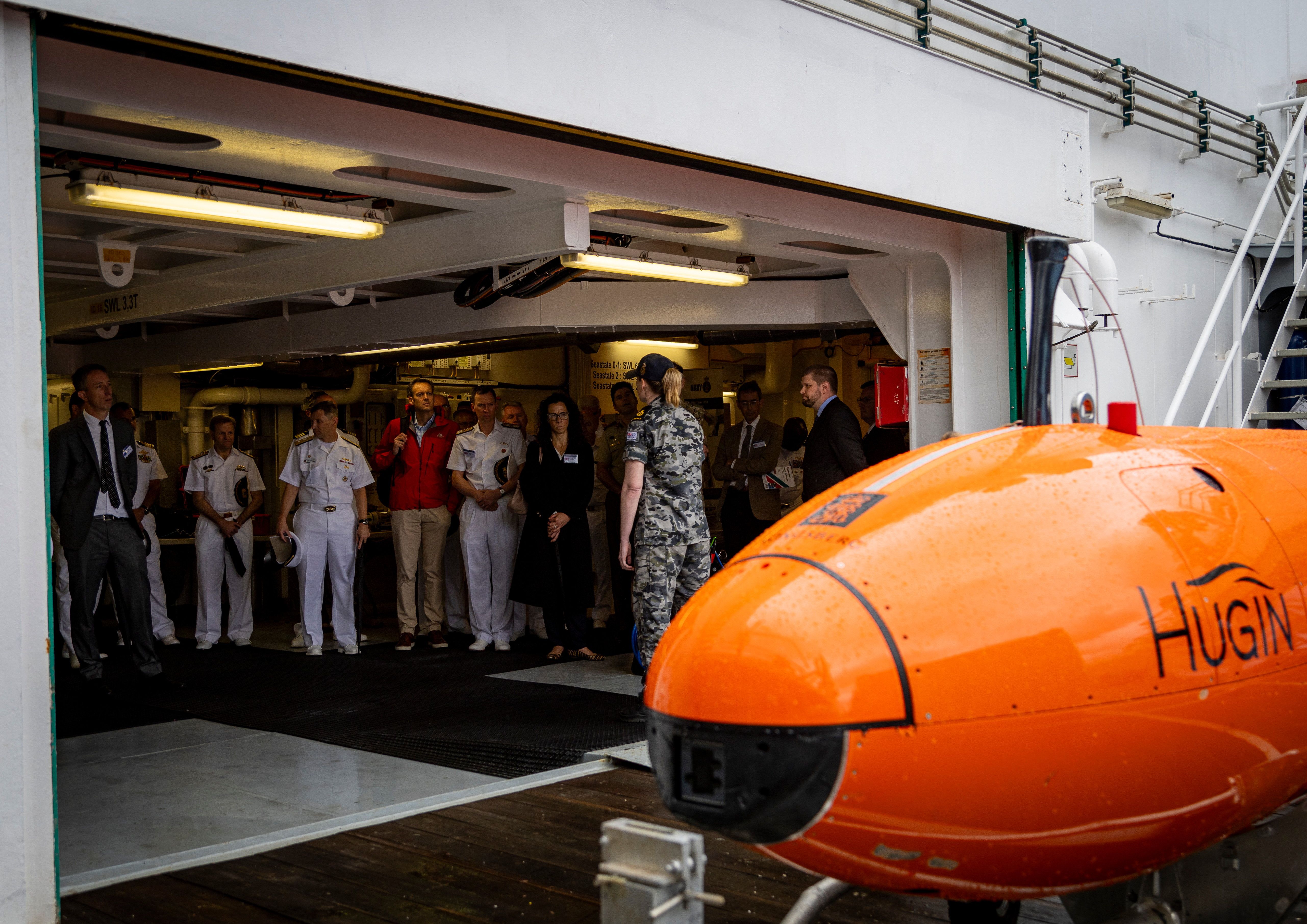
Hence the most recent milestone: the announcement of the first Pillar II signature project in May 2026, which would see AUKUS countries jointly produce shared payloads and systems for uncrewed underwater vehicles (UUVs) by 2027. This comes after years of analysts calling for a signature project to demonstrate proof of concept and for Pillar II’s priorities to be narrowed.
On paper, the logic is evident– the delivery of a UUV capability aligns with Pillar I’s focus on undersea warfare and complements surface vessel maritime operations. It also fulfils a stop-gap maritime capability for each country. Australia is expecting its first Virginia-class submarine from the United States in 2032. The U.S. is working to increase its submarine production from the current rate of 1.2-1.3 boats per year to 2.33 per year. The United Kingdom is focused on the sustainment of its Astute-class fleet, which are all currently in maintenance.
What’s Next for Pillar II?
Moving forward, Pillar II has several enduring structural challenges to overcome if it is to translate its ambitions into tangible capabilities.
First, as of September 2026, roughly 20 percent of intra-AUKUS defense trade was not captured by licensing exemptions – and these sectors are directly relevant to Pillar II capability requirements. This includes technology areas like undersea acoustics, missile technology controlled under the Missile Technology Control Regime (MTCR), and sensitive technical data and source code associated with advanced weapons and fire-control systems. Addressing this will require mitigating U.S. concerns about protecting sensitive technologies, maintaining competition within the U.S. defense industrial base, complying with domestic and international non-proliferation obligations, and preventing the compromise of critical technologies by strategic competitors.
Second, unlike Pillar I, which has clear national funding architectures centered on the acquisition and construction of SSNs, Pillar II spans a much broader set of technologies and workstreams that cut across existing national capability programs. As a result, Pillar II lines of effort have had to pull resources from existing national capability priorities. This does not necessarily require AUKUS members to establish dedicated funding streams to realize Pillar II’s potential. But the three countries must ensure that they can reliably access the resources needed to deliver Pillar II technologies, even as they compete with other national defense priorities across their broader defense industrial ecosystems.
Third, AUKUS policymakers face the question of whether Pillar II should narrow its technological scope to enable more targeted funding, senior-level attention, and industrial capacity. Doing so would involve concentrating resources toward operational requirements, including long-range strike and targeting, multidomain missile defense, command, and control, and enhanced logistical networks.
The U.K. Parliament’s Defense Committee concluded in its April 2026 AUKUS report that the breadth of Pillar II had become an impediment to delivery. This sentiment has also been reflected by the Pentagon’s scaling back in late 2025 of its initial list of 14 critical technologies – expected by the Joe Biden administration to maintain the U.S. military’s future superiority – to six: applied AI, biomanufacturing, contested logistics technologies, quantum and battlefield information dominance, scaled directed energy, and scaled hypersonics. AUKUS leaders are yet to offer clarity as to whether Pillar II is formally defining its future collaboration against operational challenges rather than its original technology categories.